It is probably fitting that the inspiration for the latest watch from GoS is a sword. It is equally fitting that the sword in question is a Viking one that was found in a village called Fullerö, just outside the famous unversity town of Uppsala (the Uppsala University was established in 1477). The area around Uppsala, including places in addition to Fullerö such as Valsgärde, Vendel and Gödåker, have long been an area of archaeological interest for its traces of Viking settlements and graves.

The ‘Fullerö Sword’ after which this new watch is named was found in 1969 by archaeologist Professor Greta Arwidson, herself from Uppsala, during a dig in the village. The sword’s surface, still very much visible, was decorated with an intricate pattern-welded core. This pattern has formed the inspiration for Patrik Sjögren and Conny Persson’s latest hand-forged Damascus steel dial project.
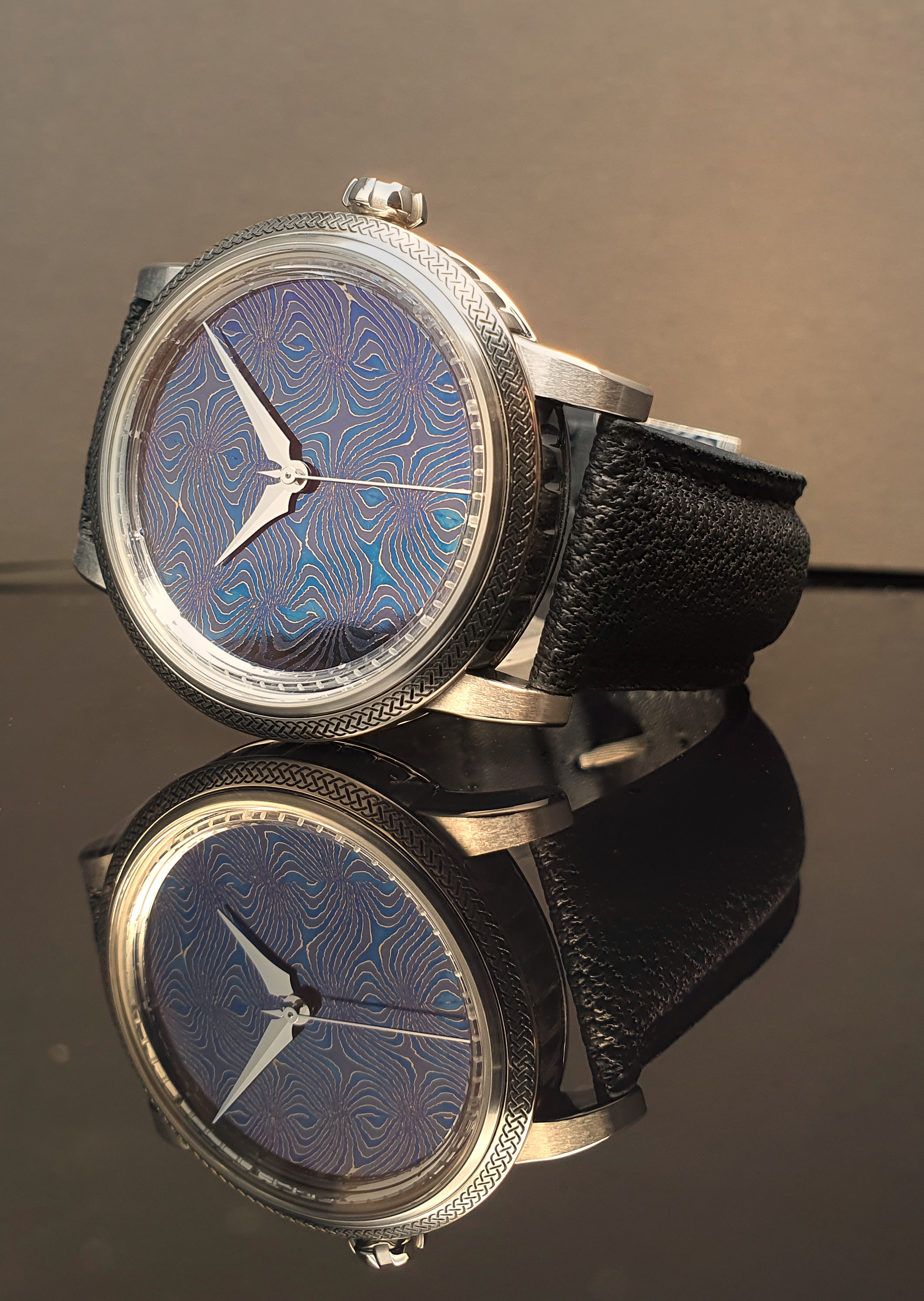
The stainless steel case is 41.5mm x 49.5mm (thickness of11mm) with water resistance of 50m. With a mix of polished and satin-finishing on the case, both the black enamel-filled bezel and case back have the GoS Viking braiding pattern. The crown is polished with bead-blasted grooves and hand-polished bevels. It has an integrated crown guard and double gaskets.

The Fullerö sword’s pattern-welded core inspired Damascus steel dial is hand-forged by Conny Persson using essentially a similar technique to that used by the Vikings. They combined two different types of steel which were made into rods, twisted, and forged together. Persson has added a layer of nickel between each layer of steel but increased the number of rods from four to seventeen layers in every rod. Patrik Sjögren finishes the dial in three options – Midnight Blue, Raw Steel, or Glowing Steel.
The index ring is made from solid sapphire crystal with hour markers created by machining the inner chamfer and the minute markers on the outer chamfer. The ring is secured onto a recess in the dial and at twelve points – twelve spaces for twelve hours. The hour and minute hands are polished white rhodium-plated.

Partially set into the case and seen basically around the sapphire ring is a clear white luminescent circle that is partially set within the interior of the case, below the index ring. Recessed into the case, the LumiCast ring has a specially developed Super-LumiNova that is used for the Völund collection. In the dark, this lumed circle shines orange, the colour choice a nod to the forging process of steel.
Powering the new GoS Fullerö Sword is the GoS-adapted automatic La Joux-Perret G101. Beating at 28,800 VPH with a power reserve of 68 hours, it has a skeletonised tungsten rotor with a gold GoS triskele emblem – the rotor for the Glowing Steel model is coloured orange (with ceramics) and the triskele is silvered. The movement has an anthracite finish.
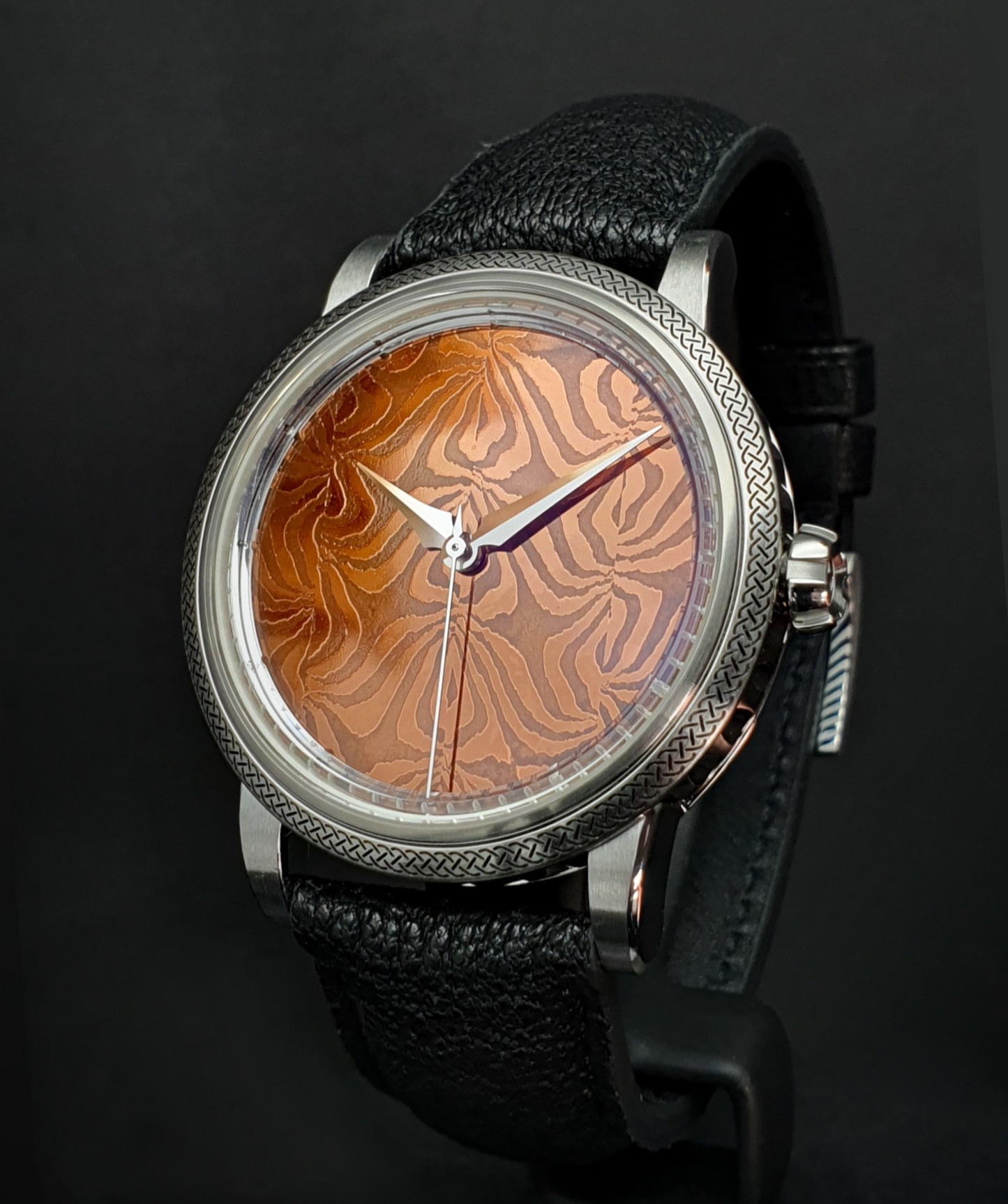
Limited in production per annum, each watch will be engraved with production number “No.XX 202X ”. The first year of production will be a maximum of twelve pieces, with the number per annum thereafter expected to be around eighteen. Coming on a black Moose strap with a Damascus steel pin buckle, the GoS Fullerö Sword will come in a hardwood box treated to look like black oak.
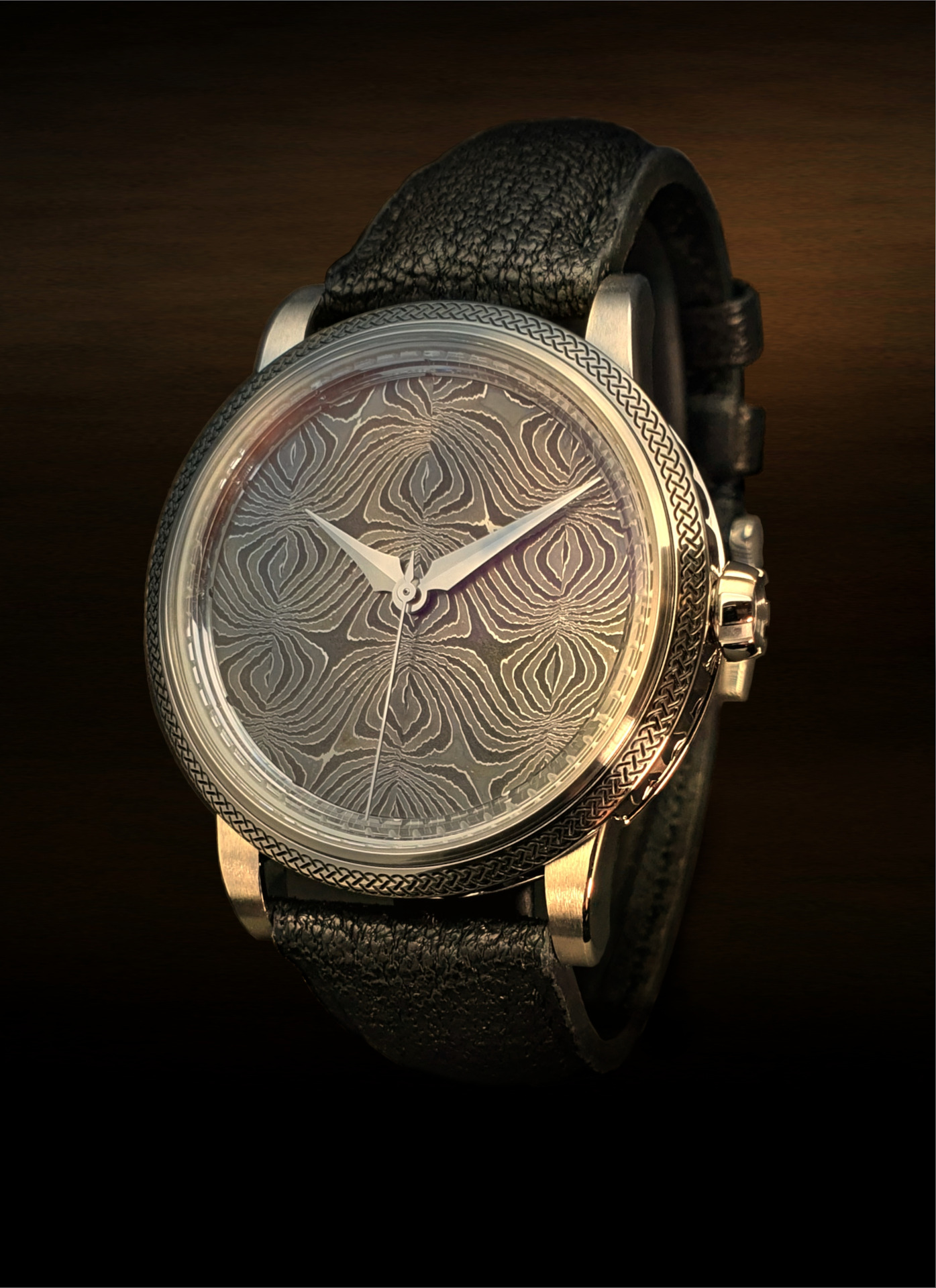
The RRPs for the three variants are USD 11,500 (excluding taxes) for the Raw Steel and USD 12,500 (excluding taxes) for the Midnight Blue and Glowing Steel.
One of Professor Greta Arwidson’s greatest contributions to Swedish archaeology relates to something called the Mästermyr Chest.
Back in 1936, one Hugo Kraft, a local farm labourer, was plowing a field on a farm owned by Emil Nordby near the village of Hemse, on Gotland when he came across a large chest. Other items such as bronze cauldrons and iron Viking objects were also found, but it was what is known as the Mästermyr Chest that became the most well-known and most studied, discovery there.
Measuring 90cm x 26cm x 24cm (9.4 in) and made of oak with iron hinges and lock, it contained over two hundred items, most of which were identified as being woodwork, metalwork and blacksmith tools from the Viking Age (789–1066) but also including three padlocks. These belongings of an unknown tradesman remains the largest discovery to date of tools made during that Age.
A curator at the National Museum recruited ethnologist Gösta Berg to help catalogue the Mästermyr find, and he brought in Greta Arwindson, both of whom would spend some half a century on cataloguing and research the Chest’s contents. You can read about it in their book ‘The Mästermyr Find: A Viking Age Tool Chest from Gotland’ by Henry T. Brown, Greta Arwidsson and Gösta Berg.
[Photo credit: GoS]
Categories: GoS, Watch Profile, watches
 HOROLOGIUM
Leave a comment