You may have thought that could not possibly be another luminosity-related release for at least a little while, but you would be mistaken.
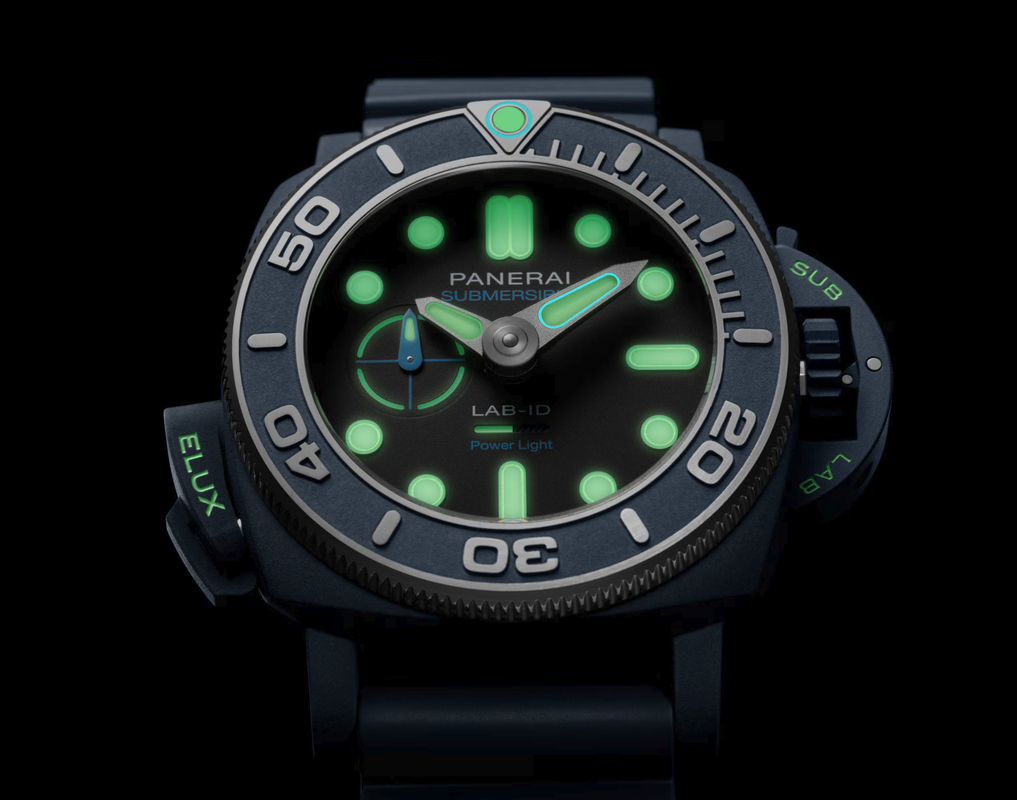
Officine Panerai has introduced the limited edition Submersible Elux LAB-ID PAM01800, a self-illuminating dive watch with a miniaturised on-demand lighting system. Yes you might be forgiven for wondering why the Submersible and not the Luminor for this latest LAB-ID model.
The ‘Flux’ name is derived from ‘elettroluminescenza’ (electroluminescence), which Panerai say was patented in 1966 and which they have brought into the 2024 in a watchmaking form. Their original form consisted of durable shock-resistant panels composed of uniformly luminous surfaces available in various sizes, shapes and materials with their luminescence constantly maintained by an electric field. The link to Panerai comes through the Italian navy Marina Militaire angle, with the panels being used by the Italian naval instruments as a light source.
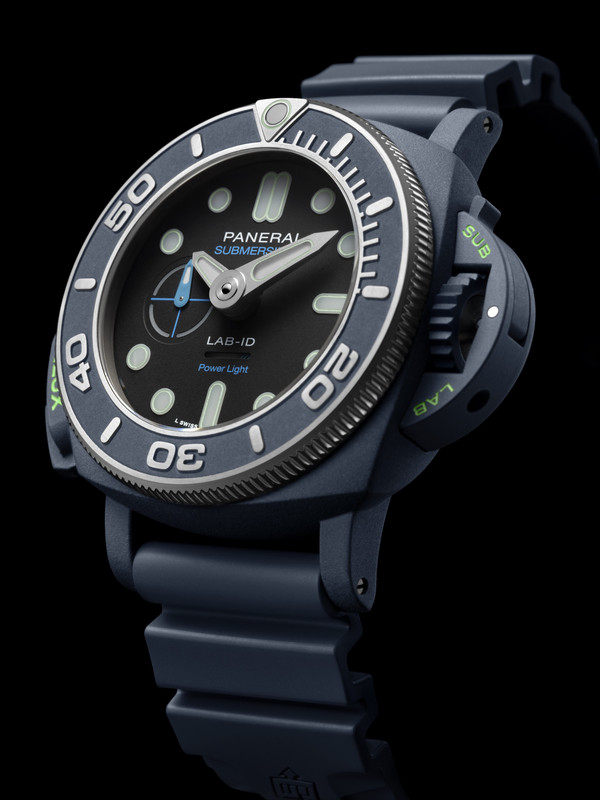
The watchmaking form consists of using mechanically powered LEDs in the new Submersible Flux LAB-ID, the electricity required generated by a self-winding movement. There are 160 micro-LEDs, including between five and ten beneath the hour markers, with the light diffused through the translucent surface of the dial.
The watch itself is 49mm of blue brushed Ti-Ceramitech™ (patent pending ceramicised titanium proprietary alloy), with a blue T-Ceramitech™ bezel and is water resistant to 500m. There is a patented pusher protection system to protect it from water pressure (it is a diving watch after all) and shock, and the on-demand lighting is activated/ deactivated via a patented push-button on the left side of the case. You simply press it to turn on/ off.
The black dial features a linear power reserve indicator (‘Power Light’) that lights up, and a small seconds at 9 o’clock. The hour markers and hour hand have Super-LumiNova X2, and the minute hand and seconds hand and dots on the bezel are all Super-LumiNova X1.
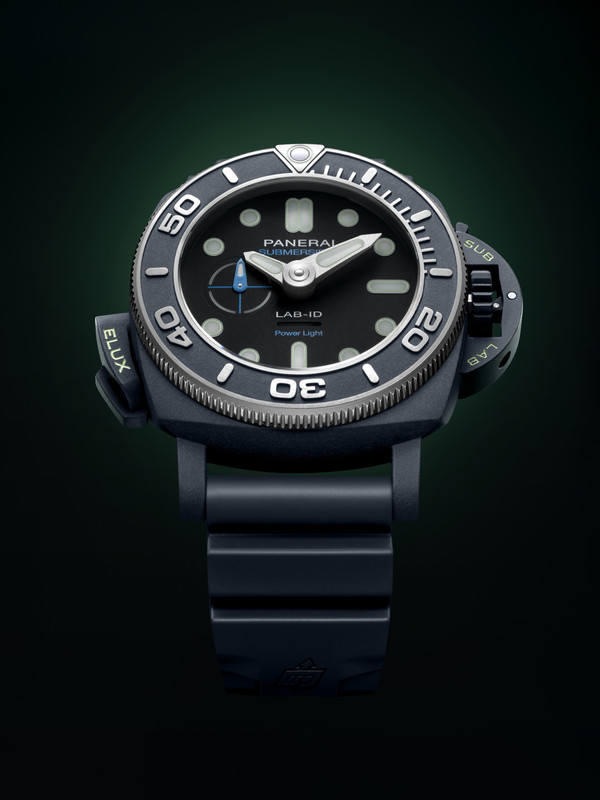
If like me, you thought oh an on-demand light activation sounds familiar even in watches, you would be correct. This has been done just a few times, most notably perhaps by Van Cleef & Arpels, but what is different about this new model is that the capacity is said to be a remarkable thirty minutes, although given that it is the barrels which provide the power for the micro LEDs, if the watch keeps on moving and thus providing power to the movement via the oscillating weight, there’s no reason to think that the luminosity capacity can’t be constantly maintained. The Elux has six barrels – two power the timekeeping and the other four generate electrical energy via a dynamo device.
Pressing the pusher releases a brake on these barrels, allowing the springs to unwind in series. A gear train accelerates the rotational speed, culminating in a rotor whipping around at 80 revolutions per second. It is attached to a micro generator with six coils, magnets and a stator, which converts the mechanical energy into a 240-Hz signal.
How is this mechanical electrical charge transferred to the rotating unidirectional diving bezel and hands? There are five micro-LEDs are in the hands. A cannon pinion made of ion polymer with conductive gold tracks is encircled by microscopic springs which maintain a circuit.
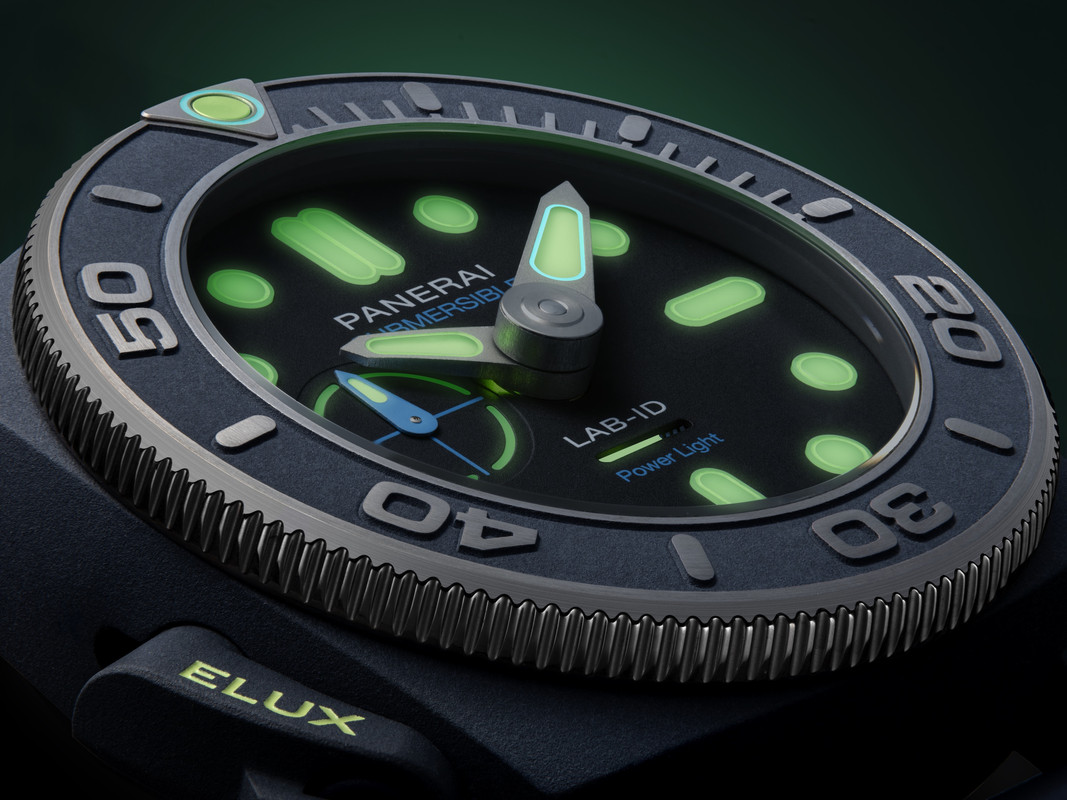
The bezel is atop the watch case, so it’s about getting the electrical power up there whilst maintaining water resistance, given they are two different parts of the ‘whole’. This is done via a connector in nested tubes and seals. The bezel contains a static ring with 60 micro-LEDs. To conserve energy, only the fifteen LEDs directly below the rotating bezel’s dot are illuminated at any given time. This is done using magnetic switches – small magnets embedded in the bezel correspond to the position of the dot. When a magnet passes over a switch, it activates the corresponding LEDs. Basic circuitry in principle but made difficult by the medium in which this has been achieve. Both the hands and the bezel technology are patented.
Four of the six barrels in the movement are dedicated to energy storage for this innovation, unwinding a microgenerator measuring 8mm x 2.3mm that converts mechanical energy into electricity. It features custom-made coils, magnets and a stator and a high-speed rotor operating at 80 revolutions per second, generating a high-frequency signal of 240 Hz that illuminates the watch’s indications, hands and bezel.
Another remarkable achievement is the mechanism’s ability to provide an extended duration of continuous light for up to 30 minutes, a significant milestone given the limited energy available compared to traditional batteries.
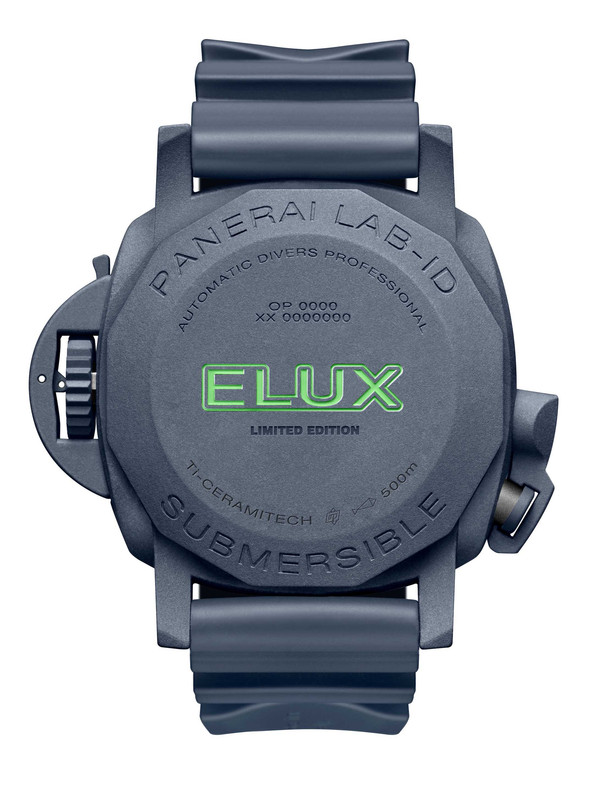
Powering it is the in-house automatic P.9010/EL. With 363 components, it beats at 28,800 VPH and has a power reserve of three days for time indication. Panerai say that unlike previous light-on-demand watches, this can continuously provide light for up to 30 minutes. Given it is powered by a self-winding movement, if it stays on the wrist, then presumably the constant motion of the wearer will supply a similarly constant supply of energy to the electrical function and thus, light.
30 minutes for on demand Power Light Function. It features six barrels: four dedicated to lighting, two dedicated to time indication, and a total of 363 components.
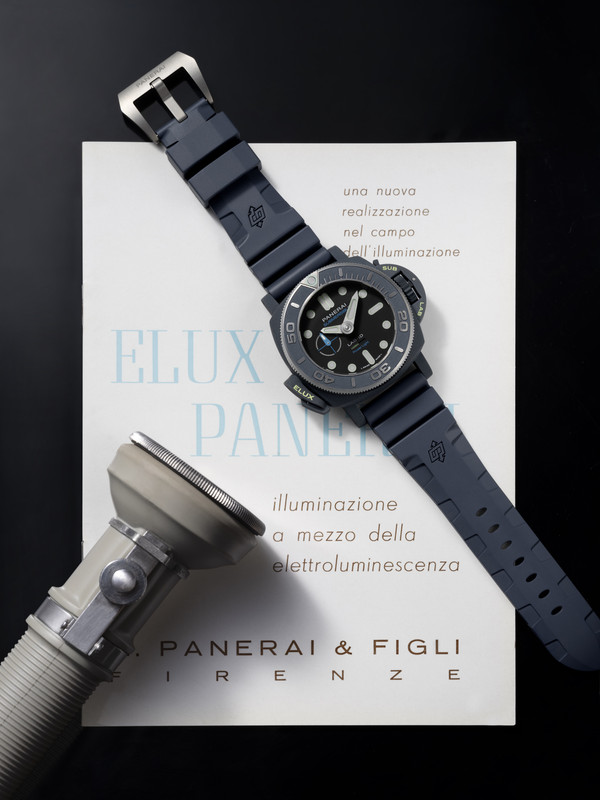
It comes on a 26mm blue rubber strap with a 22mm trapezoidal titanium pin buckle, and you get a second bi-material strap. The Panerai Submersible Flux LAB-ID PAM01800 is limited to 150 pieces, but this will be broken down to fifty pieces produced per annum over a three-year period. Available from October 2024, it has an RRP of EUR 108,000 including taxes.
[Photo credit: Officine Panerai]
Categories: Limited Editions, Panerai, Watch Profile, watches
 HOROLOGIUM
Leave a comment