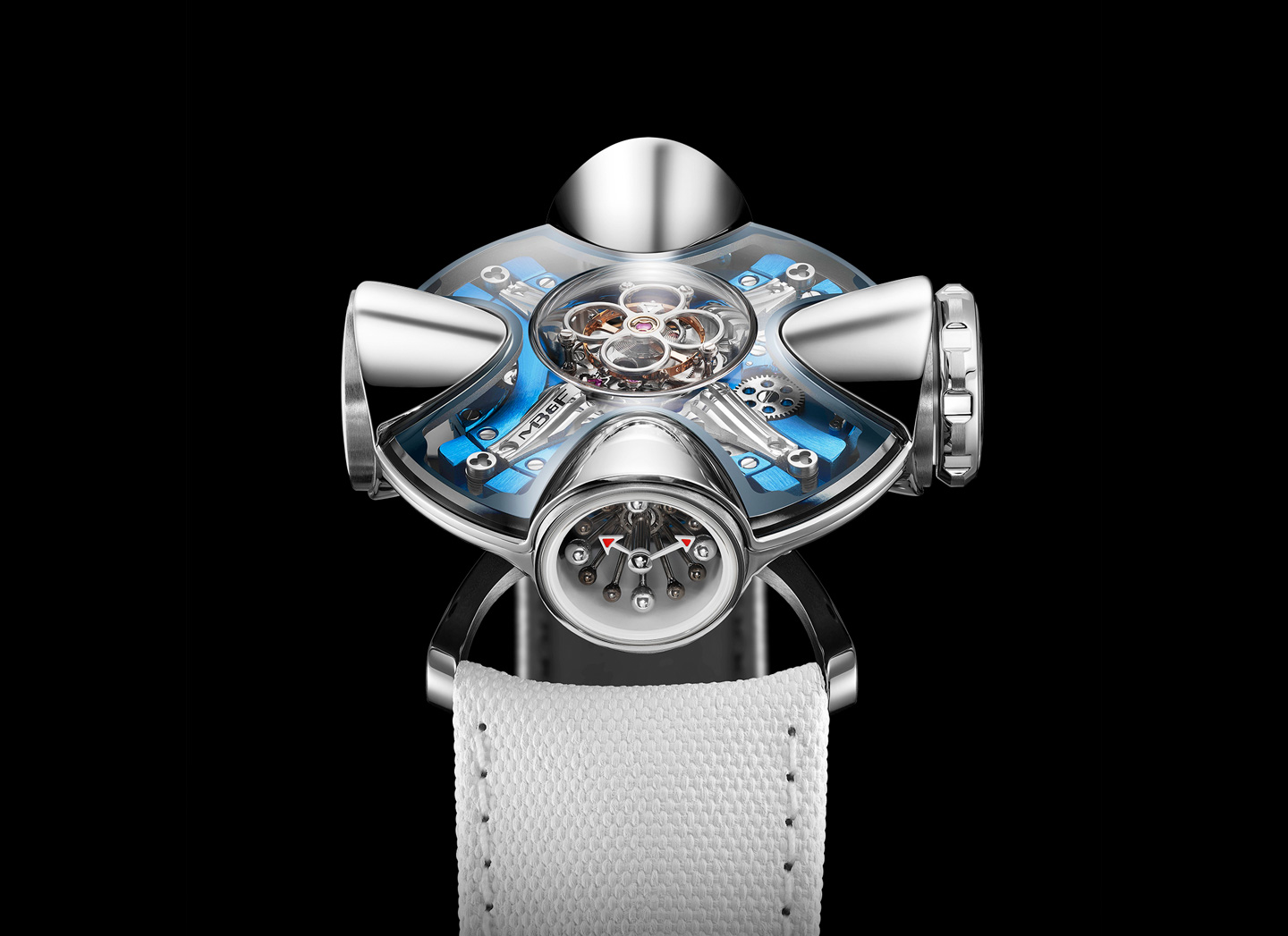
There will be many people who have been waiting for something new and unusual from MB&F, and the launch of the new Horological Machine 11 Architect is exactly this, but still bearing hallmarks that we’ve come to expect from the brand which make it distinctly theirs.
Those familiar with both the brand and Max Büsser’s approach will immediately understand the link to other pieces with the ‘what if a house was a watch?’ premise behind this new model. The concept is his, and the product design is by Eric Giroud.
The HM11 is directly influenced by architect Charles Haertling’s Brenton House in Boulder, CO (3752 Wonderland Hill Avenue 40°2’34.63″N 105°17’16.93″W if you want to look for it on Google View). The Colorado native’s works often combined elements of modernism and organic architecture. The Brenton House (aka the Mushroom House) was built as a family home for Dr. Stanley Brenton. With a design said to have been inspired by the barnacle, it has a radial design with five ‘barnacle-like’ pods. The main level spans all five pods (three of which are single level, the other two each having two levels), with the three main pods being where the main living areas are situated. It was constructed by spraying polyurethane foam over a rebar framework.
As you can see, the inspiration of this radial design with pods is reflected in the new HM11 Architect.
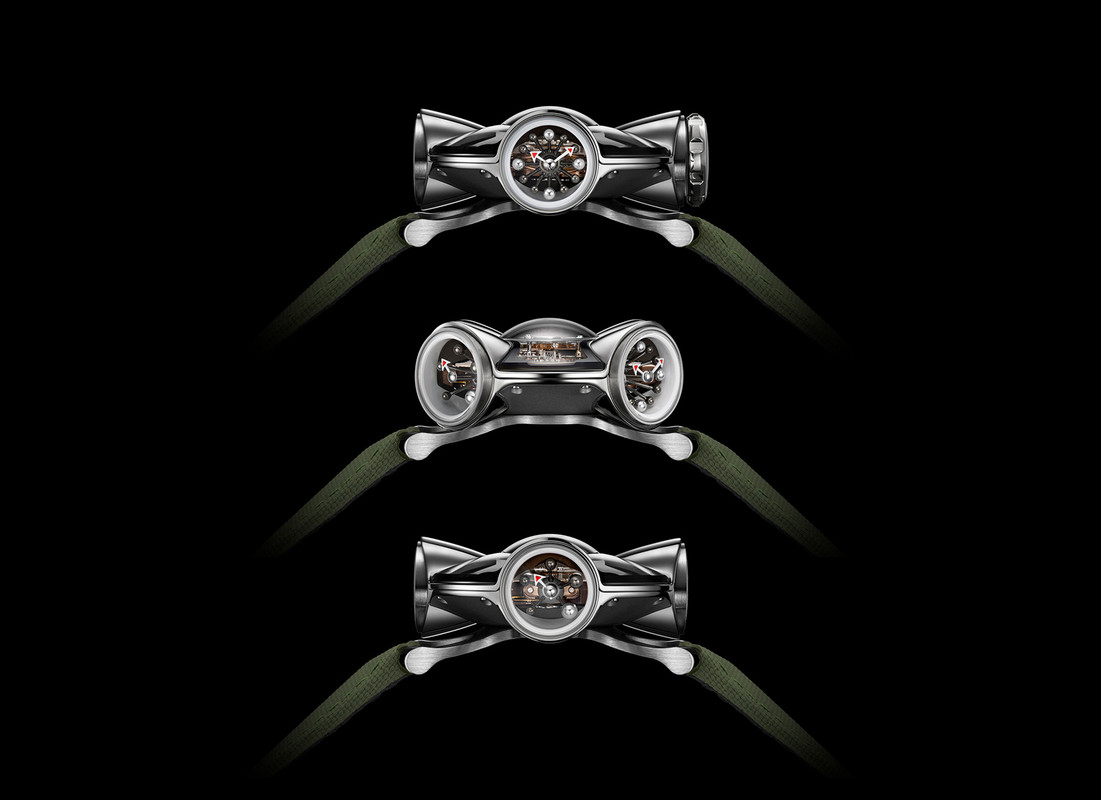
The HM11 is built around a central flying tourbillon under a double domed sapphire crystal, with four curved polished titanium sections (like the rooms of the Brenton House) that can rotate in either direction. Each 45° clockwise rotation of the case shifts one of the four functional dials or plates in a new direction, the rotations doing double duty by also winding the watch – each rotation winds the watch for 72 minutes, with ten full rotations winding it to the full 96-hour power reserve. An unusual and rather cool way of winding a watch. You can see this in their promotional film.
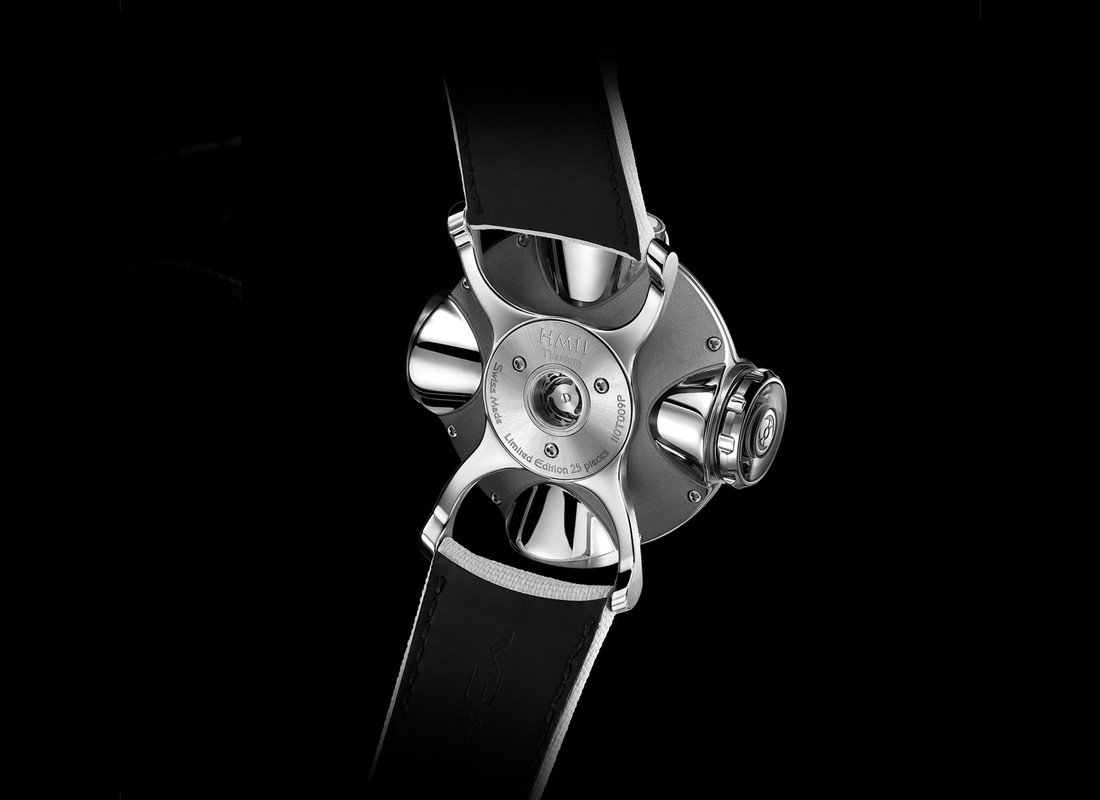
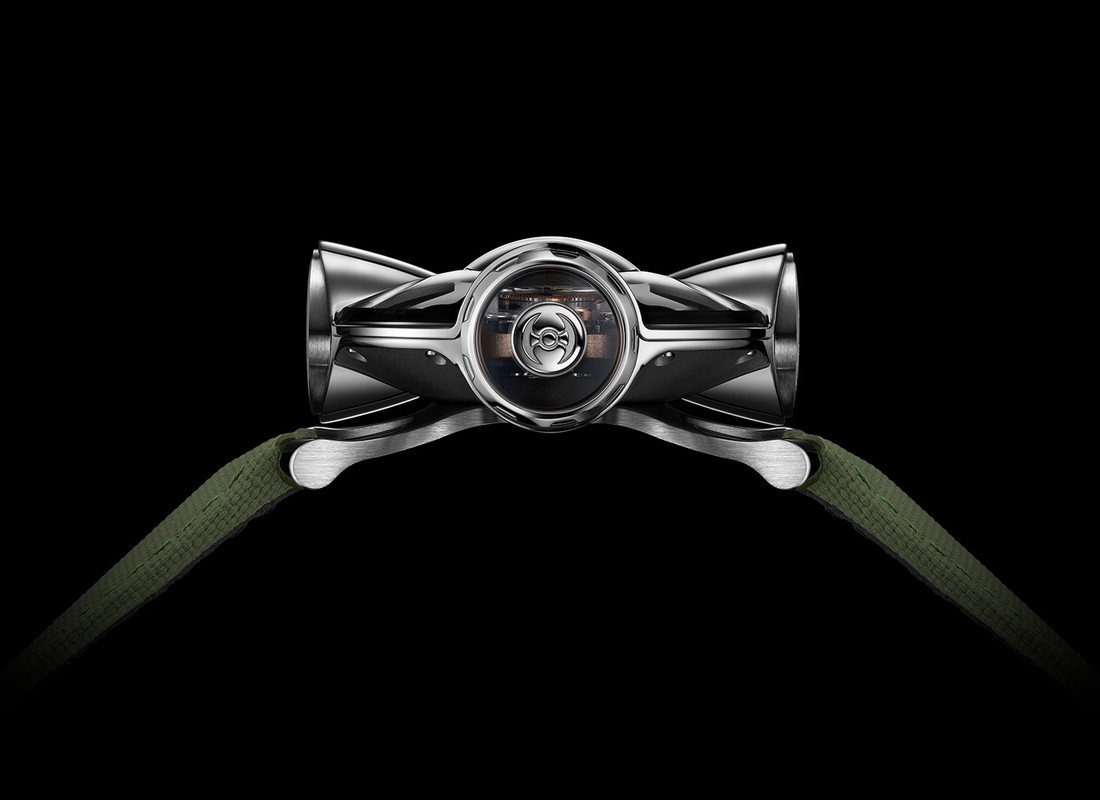
The lower half of the 42mm (23mm height) sized case is in grade-5 titanium while the upper caps are separately machined and can only be affixed once the movement is put in place. With 92 component, it takes a week to complete each case.
The display markers are a mix of conical rods in stainless steel (Ø 0.50mm to 0.60mm), darker beads in polished titanium, and lighter beads in polished aluminium (Ø 1.30mm to 2.40mm).
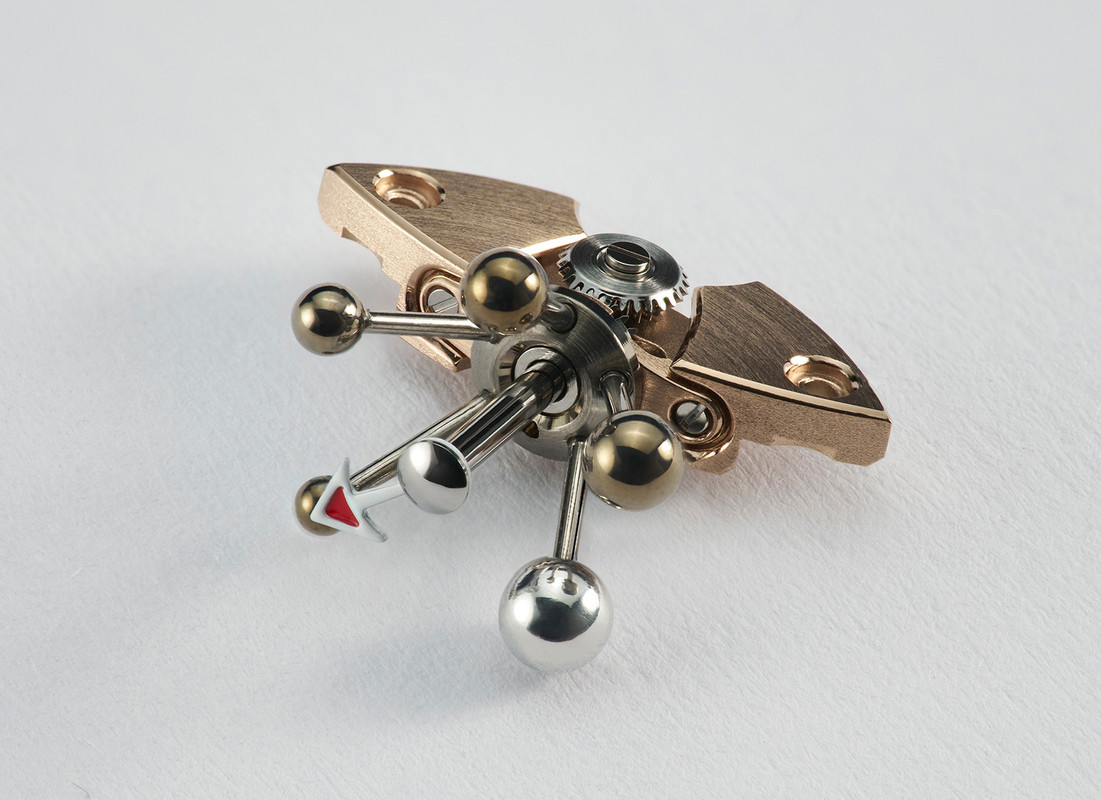
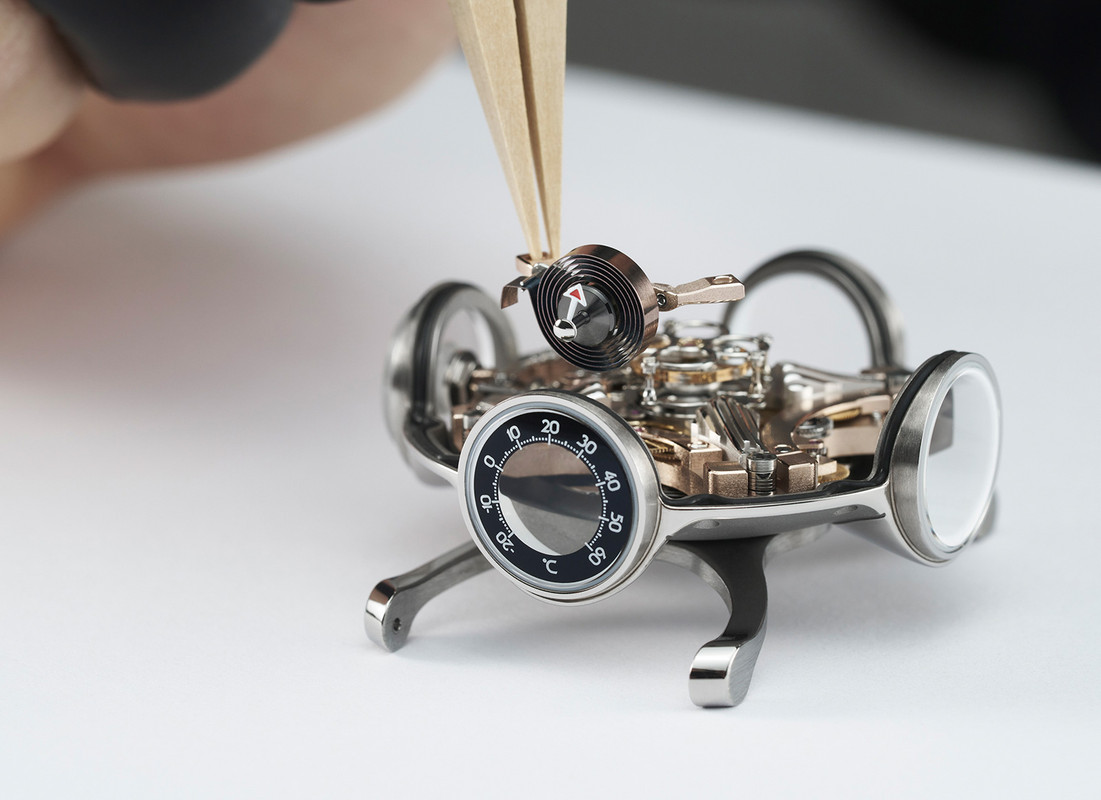
The first section (‘room’) tells the time in hours and minutes via rod-mounted orbs which serve as hour markers and red-tipped arrows serving as hour and minutes hands. Larger lighter aluminium orbs mark quarter hours and darker polished titanium orbs are used for the other minutes. The second section has a power display which also has a red-tipped arrow as a marker. A third section has, unexpectedly for MB&F, a thermometer on a bimetallic strip which you can have in either C or F. The final section is the MB&F battle-axe logo set into sapphire crystal. Pulling this out enables time setting.
The sapphire crown is part of the case and nearly 10mm in diameter. It has two sets of gaskets – one that creates a seal to protect against the ingress of dust, and a smaller gasket closer to the movement that creates a watertight seal. Not that you’re going anywhere near the water if you wear this watch, but it’s water resistance is a light splash-proof 20m and there are a total of nineteen gaskets.
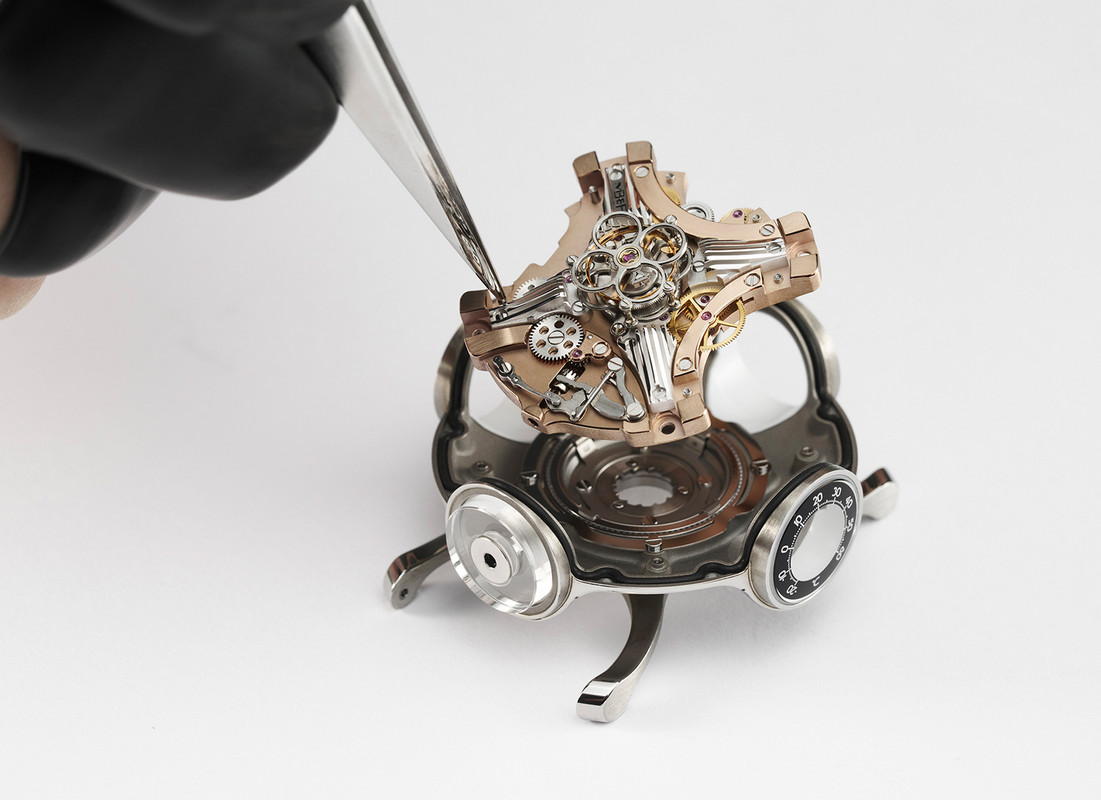
Powering this new Horological Machine is an in-house movement developed by MB&F’s Thomas Lorenzato and Robin Cotrel. Beating at 18,000 VPH, it has 364 components, and plates that are PVD-coloured either blue or 5N rose gold (according to the model variant).
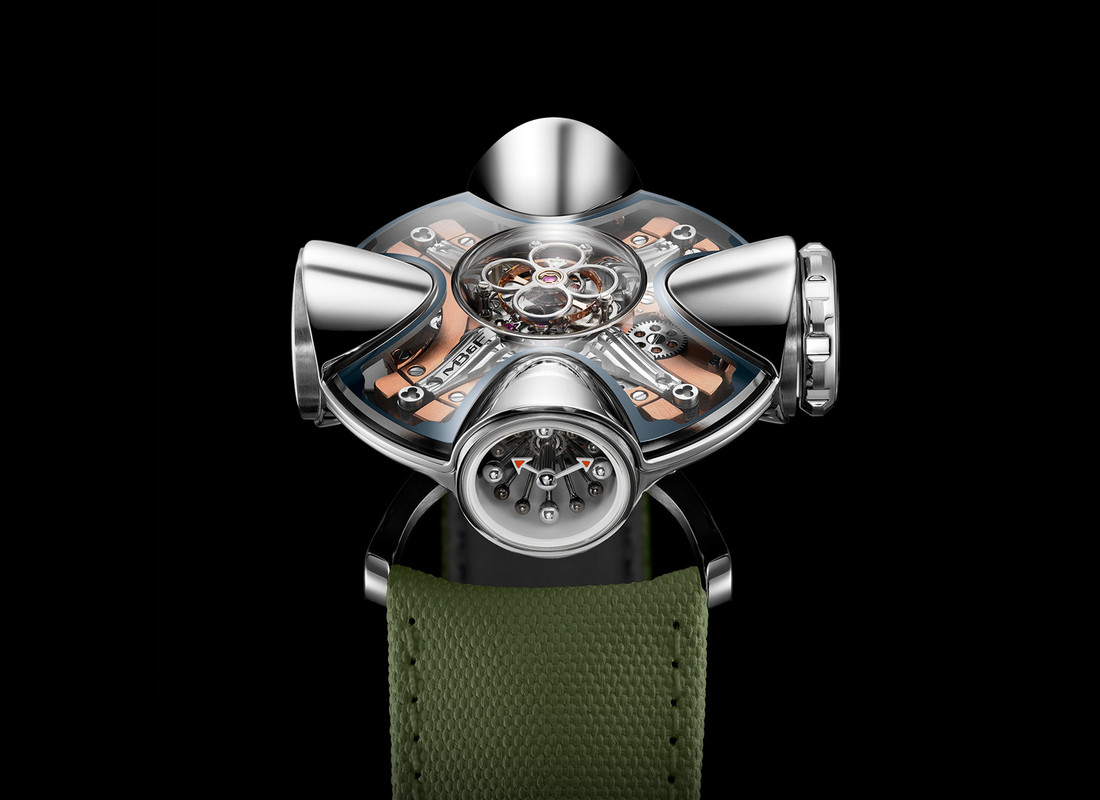
The two launch editions of the HM 11 Architect are in titanium with a blue dial plate or in titanium with a 5N red gold plate, both limited to twenty-five pieces each.
As you may have worked out from the information about the rotating winding method, the HM11 can be wound either manually or automatically through the usual way when worn on your wrist.
The flying tourbillon has a large balance wheel and a special alteration, which you can see, relating to shock protection. The HM 11 has a full-system dampener consisting of four custom high-tension suspension springs that sit between the movement and bottom half case shell. These are laser-cut from a low-carbon high-hardness steel alloy tube and have a chrome finish.
Coming on either a white or khaki rubber strap with a titanium buckle, the straps are attached on short curved ‘mini lugs’ which bring it close to the wrist. The MB&F HM11 Architect is priced at CHF 198,000.
The new Horological Machine may have been inspired by the Brenton House, but in thinking about organically-shaped houses of the 1960s and other past inspirations for MB&F, my mind also goes to the retrotastic Futuro Houses designed by Finnish architect Matti Suuronen. Shaped like the then popular cinematic stereotype of a flying saucer, fewer than one hundred were built. Made from fibreglass-reinforced polyester plastic, polyester-polyurethane, and poly(methyl methacrylate) and measuring just 4m (13ft) high and 8m (26ft) in diametre, they weren’t family homes but holiday homes and to my mind at least, are still rather cool things.
[Photo credit: MB&F]
Categories: Limited Editions, MB&F, Watch Profile, watches, Women's watches
 HOROLOGIUM
Leave a comment